



Is a room vacant, available or ready? They are not the same thing
In a hotel, people constantly use expressions such as:
“The room is vacant.”
“We still have a room available.”
“Room 204 is ready.”
In everyday language they can sound like three ways of saying almost the same thing.
Operationally, they describe three different dimensions of room management.
Confusing them can create sales errors, front-desk problems, misunderstandings with housekeeping and, perhaps most importantly, incorrect expectations for the guest.
The distinction can be summarised very simply:
Vacant describes whether someone is physically occupying the room.
Available describes whether the room can be sold or allocated for a specific stay.
Ready describes whether the room can actually receive the guest at that moment.
They are not three stages of one status.
They are three different questions.
A vacant room: nobody is occupying it
Vacancy is the easiest concept to understand.
A room is vacant when nobody is staying in it at that moment.
The previous guest may have checked out, or the room may simply have been empty.
But that information alone tells us very little about whether the room can be used.
A vacant room may still be:
- waiting for cleaning;
- under maintenance;
- out of service;
- already allocated to a guest arriving later;
- unsuitable for the stay currently being requested.
“Vacant” is therefore mainly a physical, present-time condition.
It tells us what is happening now.
It does not necessarily tell us what the property can do with the room.
An available room: can it actually be sold or allocated?
Availability belongs to a different layer.
When a guest asks for a room for three nights, the property does not only need to know whether an empty room exists today.
It needs to know whether there is a usable solution for the whole requested period, with the required characteristics.
A room may be vacant tonight but already booked from tomorrow.
Or the property may have one room free on the first night and another on the following two nights.
There may therefore be capacity across the requested period without having one physical room available continuously for the entire stay.
That is a very different issue from simply asking whether a room is vacant.
Availability depends on dates, existing bookings, out-of-service periods, allocations, holds, room capacity and the requirements of the stay.
The question “Do you have a room available?” therefore always contains another implicit question:
Available for whom, for which dates and with which requirements?
A ready room: can the guest use it now?
Then there is operational readiness.
A room may be vacant and commercially available but not yet ready.
The classic example is the period immediately after check-out.
The previous guest has left.
The room is physically vacant.
The next reservation is compatible with that room, so it is available.
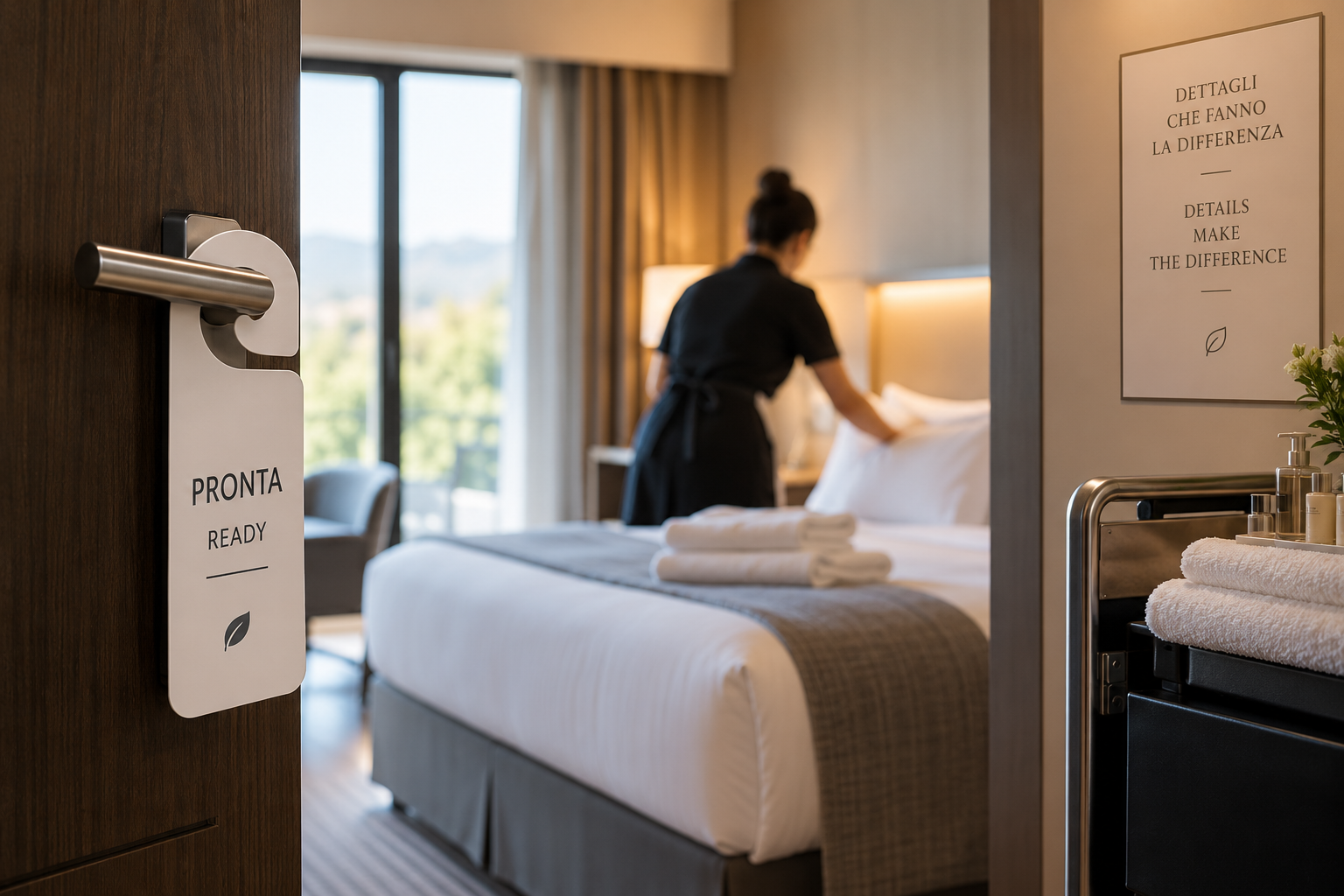
But housekeeping has not yet completed cleaning and preparation.
For the next guest, the room is not ready.
This distinction matters because cleaning status should not automatically be confused with commercial capacity.
A room that will be cleaned before the next check-in does not necessarily need to become unavailable for sale.
It may be perfectly sellable.
It is simply not yet ready to be handed over to the guest.
Three different axes, not one traffic light
The simplest way to understand the distinction is to think in terms of three independent questions.
Is someone occupying the room right now?
This is about vacancy.
Can the room be used for the requested stay?
This is about availability.
Can the guest enter the room at this moment?
This is about readiness.
The same room can therefore sit in combinations that initially sound contradictory.
Vacant, available, but not ready
The previous guest checked out at 10:00.
The next guest arrives at 15:00.
The room is vacant and compatible with the next reservation, but at 10:30 it has not yet been cleaned.
Vacant and ready, but not available
The room is perfectly clean and nobody is occupying it.
However, it is already allocated to a guest arriving later that day.
For a new walk-in requesting several nights, that room may not be available.
Occupied today, available tomorrow
A guest is currently staying in the room and will check out tomorrow morning.
The room is not vacant tonight.
It may still be perfectly available for a booking starting tomorrow afternoon.
Vacant, but not available
The room is empty but has been placed out of service because of a technical problem.
It is physically vacant.
It should not contribute to sellable capacity until the problem has been resolved.
These are simple scenarios, but they show why a single “room available: yes/no” status can hide very different realities.
The commercial problem: selling what the property can actually deliver
The distinction becomes even more important when stay continuity is involved.
Imagine a request from Monday to Thursday.
Room 101 is free on Monday night.
Room 102 is free on Tuesday and Wednesday.
At room-type level, the property may have capacity for all three nights.
But not in the same physical unit.
Can the reservation be accepted?
That depends on the property’s policy and on what is offered to the guest.
The stay could be accepted with a room move, if the guest agrees.
Or the property may decide that continuity in the same room is required.
The simple figure “one room available” does not describe the problem adequately.
The property needs to distinguish between:
room-type availability and physical-room continuity.
That distinction becomes particularly important for multi-night stays.
The operational problem: reception and housekeeping may use the same word differently
Reception and housekeeping can talk about the same room and both be correct.
Housekeeping may say:
“Room 305 is not available.”
meaning:
“It is not ready yet.”
Reception may see that room 305 is vacant and compatible with a 16:00 arrival and consider it available.
The problem is not which department is right.
The problem is that they are using the same word for two different concepts.
When terminology is imprecise, operational errors follow easily.
Reception may send a guest to a room too early.
Housekeeping may interpret a perfectly valid future allocation as pressure to release the room immediately.
Management may look at a dashboard showing “available rooms” without knowing whether the number represents sellable capacity or rooms that can be handed to a guest right now.
A good system should not force different departments to use one status for different purposes.
The most delicate issue: what do we tell the guest?
At this point the distinction stops being merely organisational and becomes part of the guest experience.
Imagine a guest arriving at noon.
Official check-in begins at 15:00.
Reception checks the system and sees that the assigned room is already vacant.
The receptionist says:
“Your room is available.”
The guest naturally understands:
“I can go to the room.”
A moment later they discover that the room attendants still need to prepare it and that they will have to wait another hour and a half.
Technically, the property may not have done anything wrong.
From the guest’s point of view, however, a promise was made and immediately withdrawn.
A better message would be:
“Your room is already vacant and we are completing the preparation. We will let you know as soon as it is ready.”
The operational situation is exactly the same.
The perception is completely different.
A clean room is not necessarily a usable room
“Ready” also deserves some nuance.
A room may be perfectly cleaned and prepared while still having a technical issue.
The air conditioning may have failed.
The electronic lock may not work.
There may be a plumbing or electrical problem.
In these cases housekeeping may have finished its work, but the room should not be used.
Operational readiness therefore depends on more than cleaning.
The property needs to distinguish between a room that is being prepared and a room that is out of service.
In the first case there is normally a temporary operational task before arrival.
In the second case there is a condition that genuinely reduces usable capacity.
Those two situations have very different effects and should not be treated as equivalent.
Why “not ready” does not necessarily mean “not sellable”
This is one of the most important distinctions.
If a guest leaves at 10:00 and the room will be cleaned by 14:00, there is little reason to remove that room from availability for a reservation starting at 18:00.
The lack of readiness is temporary.
The room still belongs to the property’s commercial capacity.
An out-of-service room, on the other hand, may need to be removed from usable capacity for several days.
If a system cannot distinguish those conditions, it risks two opposite errors:
artificially reducing availability every time a room needs cleaning;
or
selling capacity that does not really exist when a room is out of service.
Time changes the meaning of each status
There is another reason these concepts cannot be merged: they refer to different time horizons.
“Vacant” normally describes the present moment.
“Available” normally describes a requested stay interval.
“Ready” describes a specific operational moment, such as the expected handover time.
A room can therefore be occupied now, available from tomorrow, and ready tomorrow at 15:00.
All three statements can be true at the same time.
A system that tries to compress them into one value inevitably loses information.
What should a PMS show?
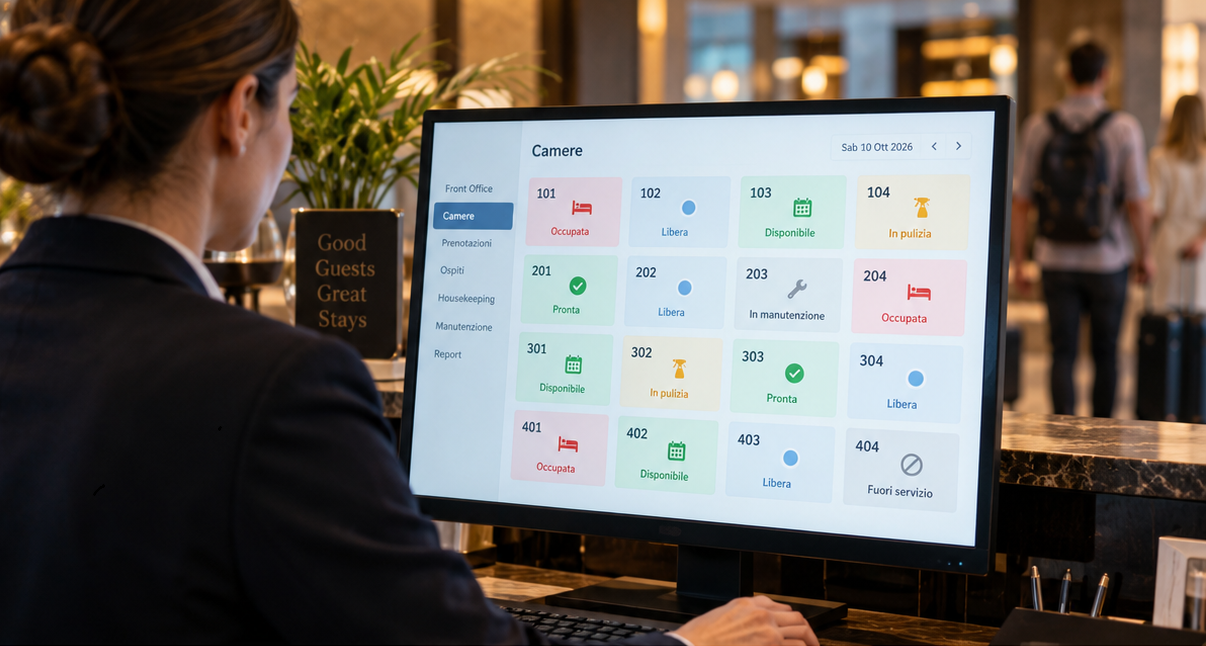
A hotel PMS should avoid representing the entire condition of a room through one generic status.
Reception needs to know, at minimum:
- whether the room is occupied;
- which stay is using it;
- when it will become vacant;
- whether it is allocated to a future booking;
- whether it is commercially usable;
- whether it is out of service;
- whether housekeeping has made it ready;
- whether an operational issue prevents handover.
That does not mean displaying eight indicators at the same time.
It means that the system should keep the concepts separate, even if the interface presents them simply.
A simple interface should not be achieved by losing important information.
A small distinction that says a lot about hotel operations
“Vacant”, “available” and “ready” may sound almost interchangeable.
In reality they describe three fundamental parts of accommodation management:
occupancy,
sales,
operations.
Confusing them can lead to incorrect allocations, unnecessary waiting at check-in, poor communication between departments and inventory errors.
Keeping them separate allows reception, housekeeping and commercial management to look at the same room from different perspectives without losing consistency.
And it is often these apparently small distinctions that reveal whether a property’s operations are genuinely well organised.
A room is not simply “available” or “unavailable”.
First, we need to understand which question we are actually asking.
Cover photo: Antonio Araujo / Unsplash.
- On 10 October 2026