
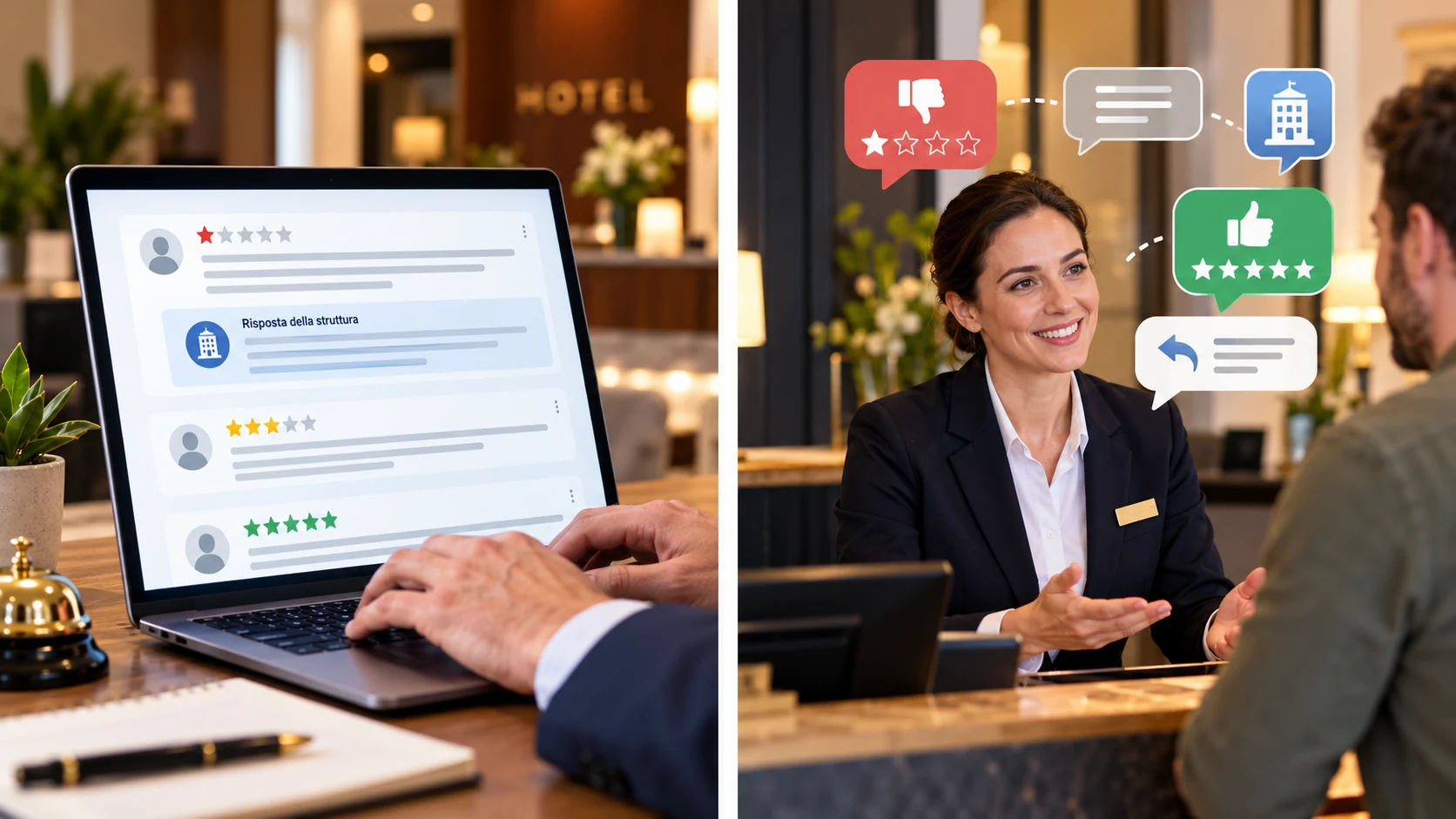
A negative review can make any hotel manager angry. Especially when it appears after a stay in which the guest never raised a complaint, when it tells only part of the story, or when it blames the property for something that, from the manager’s point of view, simply was not its responsibility.
The temptation to reply immediately is strong — and that is often exactly when it is better not to.
A review response is not a private conversation between the property and the guest. It is a public message that will also be read — and probably read mainly — by people who are still deciding whether to book.
Google explicitly reminds businesses that review responses are public and recommends keeping them professional, relevant, concise and personalised. For negative reviews, it also advises businesses to protect the reviewer’s privacy, avoid personal attacks, investigate what happened and acknowledge genuine mistakes without accepting responsibility for matters outside the business’s control.
A good response therefore does not have to prove that the hotel was right.
It should make the next potential guest think:
“If something went wrong during my stay, this property would deal with it professionally.”
That is a very different objective.
Before replying, understand what actually happened
A negative review should be treated almost like a small operational incident.
Before writing a response, it is worth reconstructing the stay: which room was assigned, whether reception notes exist, whether the guest made any requests, whether maintenance or housekeeping were involved, whether a room move took place, whether there was a billing dispute or any relevant conversation with staff.
There is no need to turn every review into a formal investigation. But replying without knowing the facts is risky.
Imagine a review saying:
“The room was dirty and nobody did anything despite our complaints.”
If reception actually received two complaints and nothing was done, the hotel has a genuine problem to acknowledge.
If, on the other hand, the guest reported a stain on the bedspread at 7 p.m. and a member of staff replaced it ten minutes later, the situation is different.
The reply should not become a minute-by-minute report of the stay, but understanding the facts helps the property decide whether it needs to apologise, explain or clarify.
Not all negative reviews are the same
For a manager, it can be useful to distinguish at least four different situations.
The first is the simplest, even if it is uncomfortable: the guest is right. Something failed. The room was not properly cleaned, maintenance was too slow, noise was not managed, check-in took too long, breakfast was disappointing or a booking mistake was made.
In this case, becoming defensive rarely helps. It is much stronger to acknowledge the problem, briefly explain what is being done to prevent it from happening again, and close politely.
The second situation is probably more common: the guest is partly right. The inconvenience was real, but an important part of the story is missing from the review.
Here, the property can add context without turning its response into a legal defence.
The third situation is when the experience was genuinely disappointing for the guest, but the property delivered what it had advertised. A room may feel small even if its dimensions and photographs were accurate. A central city hotel may be perceived as noisy. A continental breakfast may feel limited to someone expecting a large international buffet.
There is no need to tell the guest that they are “wrong”. The property can acknowledge that the experience did not meet their expectations while still giving future readers useful information.
Finally, there are reviews that appear fake, abusive, threatening or unrelated to a genuine guest experience. These need a different approach. Before fighting publicly, the property should check whether the content breaches the platform’s rules and, if so, report it.
Google allows businesses to flag reviews that violate its policies. A negative or unfair review is not automatically removable, however: there must be a policy violation, such as fake or irrelevant content or another prohibited category.
The response is not written only for the guest who complained
This is probably the most important change in perspective.
When a potential guest reads a negative review, they see two versions of the property: the one described by the reviewer and the one revealed by the hotel’s response.
An aggressive reply can actually make the original review more convincing.
Suppose the guest writes:
“The staff were rude.”
and the hotel replies:
“That is absolutely not true. You were rude from the moment you arrived and every member of staff can confirm it.”
Someone reading from the outside does not know who was right.
They do know, however, that the hotel has just argued publicly with a guest.
Older Tripadvisor research illustrates how strongly management responses can affect perception. In an Ipsos MORI study published by Tripadvisor in 2019, 89% of respondents said that a thoughtful response to a negative review improved their impression of the business. The study is not recent and should be treated as historical evidence, but the principle remains useful: the audience for your response is much larger than the person who wrote the review.
A simple structure for a good response
There is no need to use the same formula every time. In fact, obviously standardised responses quickly make it look as though nobody actually read the review.
A good response can nevertheless follow a fairly consistent structure.
First, acknowledge the guest’s experience. Then address the specific problem when necessary. Admit what genuinely went wrong or add the missing context. Finally, where appropriate, explain what was done or what will be done.
And do it without writing an essay.
Google itself recommends clear and simple responses. A reply that is too long risks losing the reader and turning a limited problem into the main story about the property.
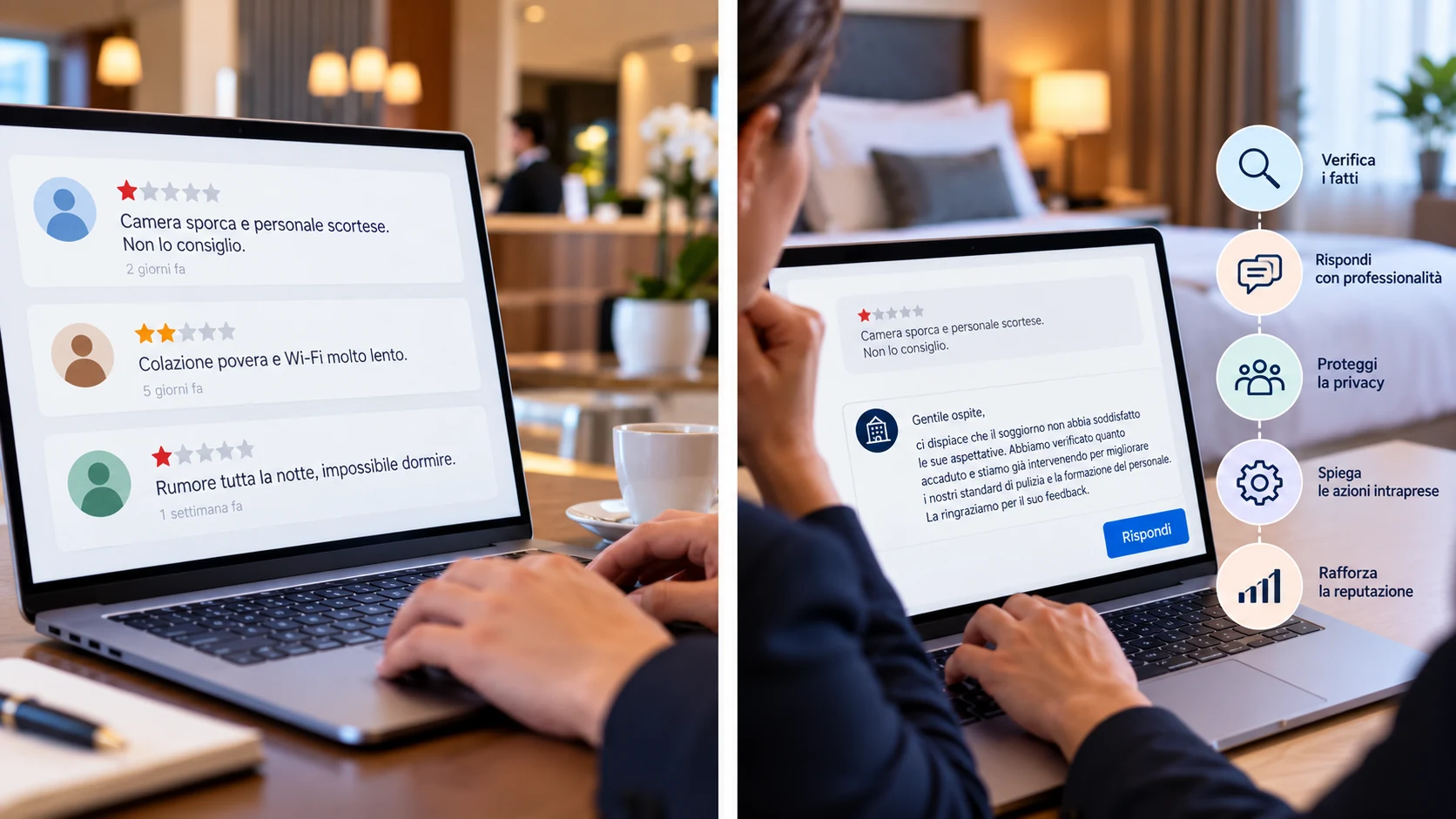
Let us look at some practical examples.
Example 1: the guest is right
Review:
“The room was clean, but the air conditioning did not work. We reported the problem twice and unfortunately it was never fixed during our stay.”
A possible response:
“Thank you for letting us know what happened. We are particularly sorry that, despite your reports, we were unable to solve the issue during your stay. In this case, our response was not fast enough. We have already reviewed both the technical fault and the way the report was handled internally. We hope to have the opportunity to provide you with a better experience in the future.”
There is little value in explaining that the technician was unavailable, that a spare part had not arrived or that the outside temperature was exceptionally high.
If the problem was ours, demonstrating that we understood it is usually much stronger.
Example 2: the problem was real, but part of the story is missing
Review:
“They made us change rooms during our stay without any explanation.”
Suppose the booking had been knowingly confirmed using two different rooms because no single room was available for the entire stay.
A response could be:
“We are sorry that the room change affected your experience. In your case, the booking was confirmed from the outset using two different rooms because the same room was not available for all the requested nights, and this arrangement was indicated at confirmation. We nevertheless understand that changing rooms can be inconvenient, and we are sorry if the information provided was not sufficiently clear.”
We are not saying: “We were right.”
We are giving future guests the missing context without discrediting the reviewer.
Example 3: the complaint concerns a feature that was accurately advertised
Review:
“Great central location, but far too noisy. Impossible to sleep with the windows open.”
An aggressive reply would point out that the guest voluntarily booked a city-centre hotel.
A more useful response might be:
“Thank you for sharing your experience. Our central location is one of the aspects many guests appreciate most, but we understand that outside noise can be an issue for guests who prefer sleeping with the windows open. Our rooms have sound-insulated windows and, subject to availability, we can also recommend quieter rooms. We suggest mentioning this preference when booking so that we can advise you accordingly.”
The negative review has now become useful information for the next guest.
Example 4: a harsh review based on different expectations
Review:
“Terrible breakfast. Hardly any choice.”
Before responding, the hotel needs to understand what it actually offers.
If the website promises “a generous international breakfast” and guests receive only coffee, a packaged croissant and juice, the hotel has a real problem.
If the offer is accurately described as a simple Italian-style breakfast, the response can take a different direction:
“We are sorry that our breakfast did not meet your expectations. We offer a predominantly Italian-style breakfast, as described in our service information, and we understand that it may feel less varied to guests who are used to large international buffets. Your feedback is nevertheless useful and we will keep it in mind when reviewing our future breakfast offer.”
The important thing is not to use the website description as a weapon against the guest.
Example 5: an accusation the property believes is false
Review:
“They charged me for services I never requested and refused to refund the money.”
This needs caution.
If the property has clear documentation, it can provide context without publishing the guest’s bill, room number, exact dates, consumption details or other personal information.
A possible response:
“We are sorry to read this account. We have reviewed the stay and the documentation relating to the charges and cannot identify any services applied without authorisation. Out of respect for your privacy, we prefer not to discuss the details publicly, but we remain available to review the matter directly with you through our official contact channels.”
That is very different from:
“You drank three bottles from the minibar and we have your signature.”
Even when a hotel has evidence, publishing it is not automatically a good strategy.
Google specifically recommends not disclosing private information about reviewers in public responses.
Example 6: “We cannot find your booking”
This has become an almost standard reply:
“We have no record of any guest under this name.”
Sometimes that is completely true. But on its own it does not prove that the review is fake.
The booking may have been made in a partner’s name, through a company, by a tour operator or by another member of the group.
A better response could be:
“We have not been able to match the experience described to an identifiable stay using the information available in the review. We would still like to investigate what happened. If you stayed with us, please contact us through our official channels with the approximate dates of your stay and the name under which the booking was made.”
If there is genuine evidence suggesting that the review is false, the property can also use the platform’s reporting procedure.
What should never appear in a public response
The fact that a response is public suggests a useful rule:
Do not write anything you would not want to see isolated in a screenshot and shared on social media without the rest of the conversation.
That means avoiding insults, sarcasm, personal accusations, threats and confidential details about the stay.
It also means not trying to buy the removal of a review.
Google treats offering free products, services or discounts in exchange for posting, changing or removing a review as fake engagement.
There is a difference between asking a satisfied guest, after a problem has genuinely been resolved, whether they would like to update their review voluntarily and making a refund, discount or benefit conditional on removing it.
Apologising does not necessarily mean admitting everything
Some managers avoid any form of apology because they fear it automatically means accepting liability.
But different types of apology communicate different things.
“We are sorry that your stay did not meet your expectations” acknowledges the guest’s experience.
“We are sorry about the forty-minute delay at check-in” acknowledges a specific fact.
“We accept full responsibility for all the damage you suffered” is something entirely different.
The response should be proportionate to what the property actually knows.
Empathy and precision can coexist.
When to move the conversation away from the public review
Some situations cannot be resolved in ten lines: financial disputes, refund requests, accusations against members of staff, health or safety issues, lost property, damage or matters that may have legal implications.
In these cases, the public response should remain concise.
Acknowledge the issue, say that the property wants to investigate it seriously, and invite the guest to continue the conversation through a direct channel.
That does not mean hiding the problem.
It means avoiding the management of a complex case in a public forum.
Responding quickly does not mean responding impulsively
Speed matters. Google lists timely responses among the good practices for dealing with negative reviews.
But there is a difference between replying quickly and replying while angry.
If a review has genuinely irritated us, the professional solution may be to write the response, not publish it, and read it again thirty minutes later.
Often, two sentences can simply be removed.
They are usually the two sentences we would have regretted.
What about AI-generated responses?
AI can be very useful for creating a first draft, translating a response or helping staff maintain a professional tone.
It becomes a problem when it replaces knowledge of the actual stay.
A perfectly polite but generic response such as:
“Dear guest, we are very sorry about your experience and thank you for your valuable feedback, which will help us improve our services.”
may be grammatically flawless while saying almost nothing.
If every review receives the same response, with only the guest’s name and perhaps one word about breakfast changed, the result does not communicate attention.
It communicates automation.
AI should help someone who knows the facts write better. It should not invent the facts on their behalf.
The same principle should apply to hotel management software. A system can collect information, retrieve the context of a stay, suggest a draft response and support the operator, but the final decision about what to communicate should remain with the property.
A negative review can also reveal an operational problem
There is one final aspect that is easy to overlook when the discussion focuses only on online reputation.
A negative review may be fair, unfair or exaggerated. But if five different guests complain about the same issue in the same month, the hotel may no longer have only a review problem.
It may have an operational problem.
“Low shower pressure”, “slow check-in”, “cold room”, “unstable Wi-Fi”, “morning noise”, “breakfast not replenished”: when the same comments start appearing repeatedly, they become data.
A well-organised property should be able to connect them to rooms, dates, departments and internal service reports. That is where reputation management and hotel operations begin to meet.
The value of a review therefore does not end when the hotel publishes a response.
Sometimes the most important response is the one the property gives to its own internal process.
In conclusion
A negative review is unpleasant, but it is not automatically damaging to a hotel’s reputation.
A defensive, generic or aggressive response can be far more damaging.
Before replying, it is worth reconstructing the facts, separating what actually happened from the guest’s expectations, protecting privacy and remembering that the message is also being read by people who have not yet stayed at the property.
If we made a mistake, we can say so.
If part of the story is missing, we can add context.
If the guest simply has a different opinion, we do not necessarily need to convince them.
If the review breaches the platform’s rules, we can report it.
The objective is not to win an argument.
It is to show publicly how the property handles a problem when something goes wrong.
Last updated: 27 October 2026
Main sources
- Google Business Profile Help — managing and responding to customer reviews.
- Google Business Profile Help — reporting reviews that violate Google policies.
- Google Maps / Business Profile — prohibited and restricted content policies.
- Tripadvisor / Ipsos MORI, 2019 study on management responses to reviews.
This article is intended for general operational and informational purposes. Platform procedures and policies may change over time; businesses should always check the current rules of the relevant service when reporting, disputing or requesting the removal of a review.