

A reservation comes in through Booking.com. A few minutes later, another traveller checks your hotel website for the very same dates. Meanwhile, the front desk is changing an existing guest’s stay.
Each action seems routine. But all three depend on one thing: the property, its sales channels and its website must be working with consistent information.
This is where three terms appear again and again in hospitality technology: PMS, Channel Manager and Booking Engine. They are sometimes sold separately, sometimes included in the same package and often described as if they were interchangeable.
They aren’t.
A Property Management System (PMS) helps a hotel or guesthouse manage reservations, guests, accommodation and everyday operations. A Channel Manager connects the property’s sellable inventory and rates with online distribution channels. A Booking Engine lets guests make direct reservations through the property’s own website.
Think of them as different parts of the same booking journey. Understanding where one responsibility ends and another begins is more valuable than simply buying a platform with a long list of modules.
Three different jobs behind one guest experience
The PMS: where the property manages its day-to-day work
PMS stands for Property Management System. Its primary job is to organise what happens inside an accommodation business.
Picture a twenty-room independent hotel on a busy Friday. Guests are checking out, early arrivals are asking about their rooms, housekeeping is updating room readiness and reception has several date changes to deal with.
Staff need more than a list of occupied dates. They need to understand who is arriving, what accommodation has been promised, which room is suitable, what the guest has paid for and what still needs doing.
A PMS brings that information into a coherent operational context. Depending on the product, it may support quotes, reservations, room assignments, stay management, additional services, housekeeping, guest records and administrative processes.
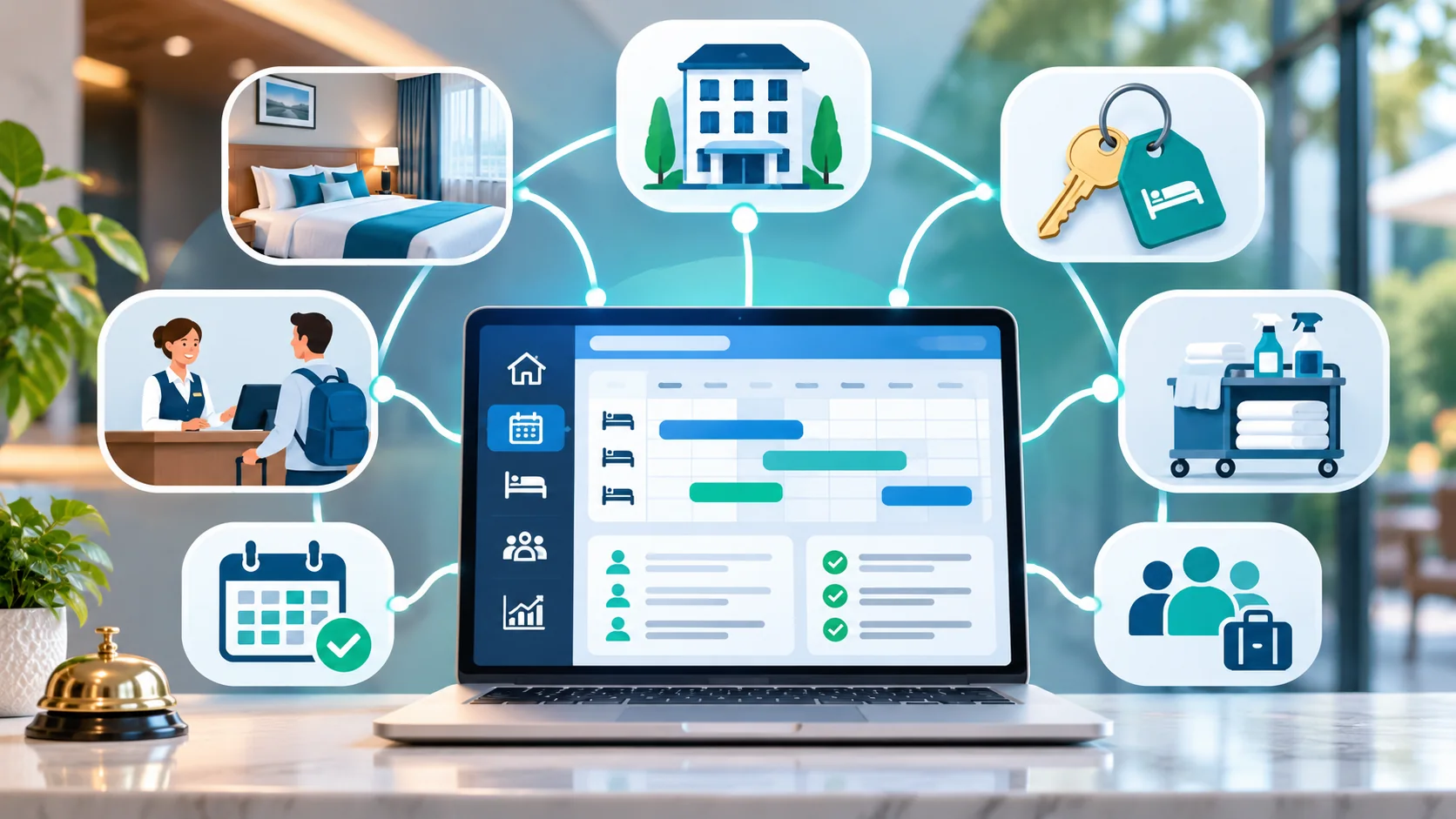
The details vary between systems; the essential point does not. A PMS is principally concerned with the running of the property and the stays it has agreed to provide.
That is why choosing a PMS is not quite the same decision as choosing a way to advertise rooms online. A hotel can have a well-organised reception and still lack a connection to a particular booking website.
For an example of the operational approach, see the OpenBuuk Hotel PMS overview.
The Channel Manager: keeping online sales channels aligned
Now imagine the same hotel offers its rooms through Booking.com, Expedia and several other booking platforms.
Each channel needs to know what accommodation can be sold, at which rates and under which conditions. If the last available double room is booked on one channel, the others should receive the corresponding update.
Doing this manually across multiple dashboards is time-consuming. More importantly, it leaves room for mistakes when reservations arrive close together.
A Channel Manager exists to coordinate that distribution. It exchanges availability, rates and, where supported, restrictions with connected channels; depending on the integration, it can also receive reservations and pass their details to the PMS.
Its job is not normally to manage housekeeping, welcome guests or organise a room change after check-in.
A Channel Manager is about the sale and distribution of accommodation, not the entire operation of the stay.
Even the phrase “connected to an OTA” deserves a closer look. Not every connection supports the same rate structures, restrictions, updates or booking information. Those details should be verified for each channel a property actually uses.
The Booking Engine: turning your own website into a direct booking channel
A potential guest finds your property through a search engine, a social media post or a recommendation. They like what they see on your website and want to reserve a room.
Without an online booking function, they might have to email, call or leave your website to complete the reservation elsewhere.
A Booking Engine makes it possible to choose dates, compare suitable accommodation, review the relevant conditions and complete a reservation directly through the property’s website.
The Booking Engine is therefore the guest-facing part of the direct booking process. It needs reliable information about what can be sold and on what terms, but it is not itself a substitute for the hotel’s operational PMS.
Nor does direct booking automatically mean a transaction without costs. Payment providers, software subscriptions and other services may still charge fees. The benefit is that the property offers a sales route of its own, rather than relying entirely on third-party booking platforms.
There is another important distinction: a contact form asking a guest to request availability is not necessarily a Booking Engine. It might begin a conversation, whereas a Booking Engine can complete a booking under defined rules.
A weekend booking: how the three systems should work together
The easiest way to understand the relationship is to follow a reservation through a realistic situation.
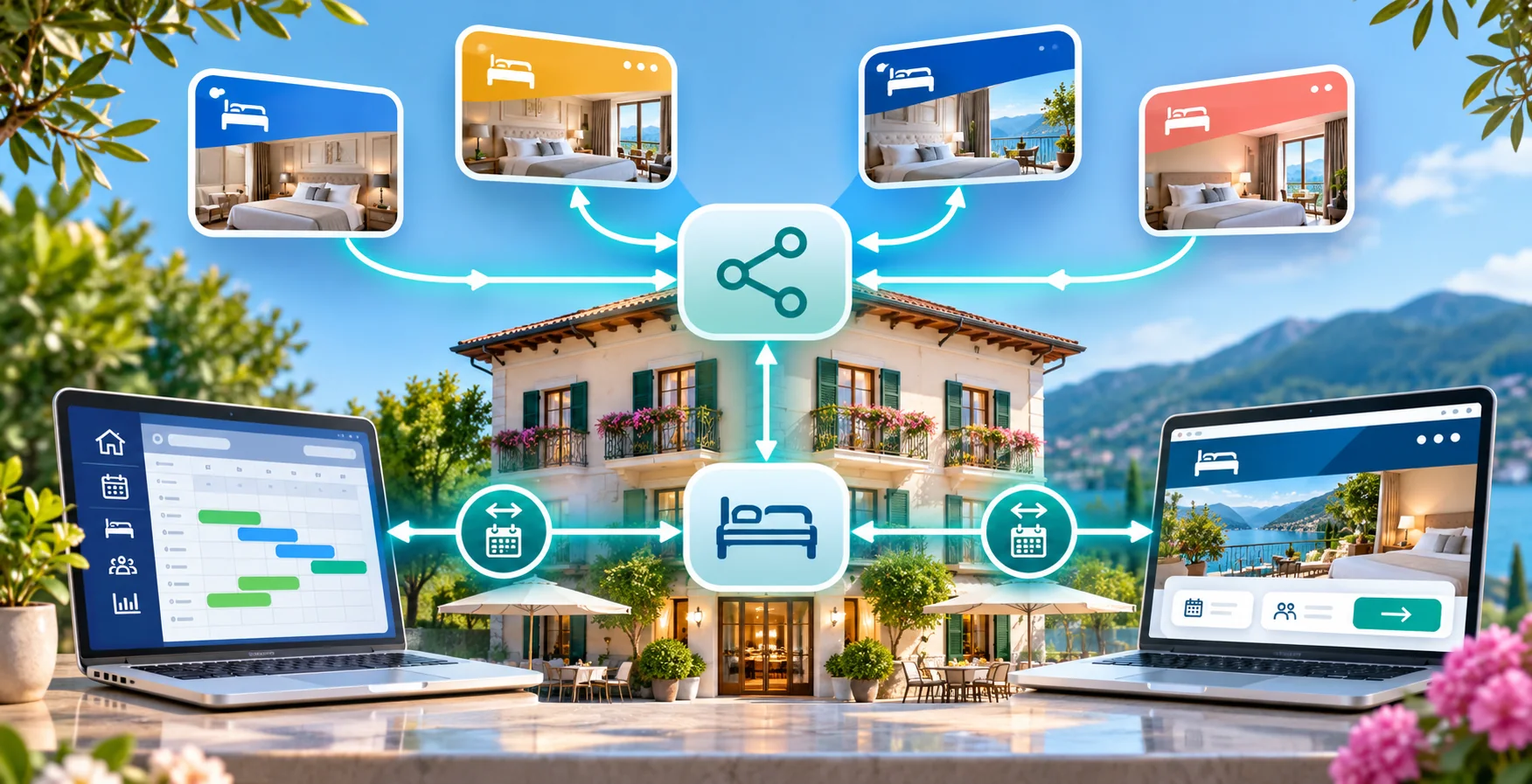
Imagine a hotel with twelve double rooms. For an upcoming weekend, only two remain available for sale.
The hotel accepts bookings through an online travel agency (OTA) and its own website. It has a PMS to manage reservations and stays, a Channel Manager connected to the OTA and a Booking Engine for direct reservations.
First, a reservation arrives from an OTA
A traveller books one of the remaining double rooms through Booking.com.
Through the configured connection, the reservation is received and the property’s availability needs to be updated. The sellable quantity in our example falls from two rooms to one.
The updated information must reach the other connected sales channels. It should also be reflected in the availability offered through the hotel’s own direct booking process.
Meanwhile, the PMS needs the reservation information for the work that follows: the guest’s arrival, room allocation, stay and departure.
The commercial change and the operational record are closely related, but they are not identical responsibilities.
Then another guest books on the hotel’s website
A second traveller checks the hotel website for the same dates.
If only one double room remains sellable, the Booking Engine should not ordinarily confirm two more rooms, unless the property is deliberately using an overbooking policy that allows it.
The guest selects the available option and completes the reservation. The system responsible for inventory must reflect that commitment, and the connected distribution channels must receive the appropriate updates.
In our simple example, no double rooms now remain for sale for that period.
The key point is not which product’s logo appears on the screen. It is whether the booking is recorded correctly and whether every place offering availability receives a consistent view.
Finally, reception changes an existing stay
The first guest calls to arrive one night earlier.
Changing a date is not just a matter of editing a calendar entry. The property needs to check the extra night, any applicable rate difference, room continuity and the conditions of the amended reservation.
If that additional night affects sellable inventory, the change must also propagate to the relevant channels.
When the process is properly connected, staff can see what has changed and what has been promised. When only one system is updated, discrepancies begin to accumulate.
Good integration is not simply moving booking details from one application to another. It is keeping the commitments made to guests consistent with what the property can actually deliver.
Who owns availability? The most important question is often overlooked
Software demonstrations frequently show an attractive calendar updating automatically. But a more revealing question is: which system has the authority to decide what is available to sell?
There is no mandatory answer for every hotel technology setup.
In some architectures, the PMS is the main source of reservation and inventory information. Other businesses use a central reservation or distribution system, dedicated allotments, pooled inventory or separate rules for different channels.
What matters is that each decision has a clearly defined owner.
If a room is temporarily taken out of service, where is that recorded? If a booking is cancelled, when does its inventory become sellable again? If a room type is oversold by design, who controls the policy? If a rate plan changes, which component holds the authoritative values?
These are not questions that every front-desk employee needs to answer technically. But the supplier should be able to explain the behaviour in practical terms.
Physical room status and commercial availability are not the same
A room can be physically empty yet unavailable for sale because of maintenance, an existing allocation or restrictions on a particular booking.
A hotel may also have an available room for each individual night without being able to offer the same physical room for an entire multi-night stay.
That is why occupancy, readiness and sellable inventory should not be treated as synonyms.
The PMS may know which physical room is undergoing cleaning. The distribution layer needs to know what can safely be offered for sale. Those two views must remain compatible even though they serve different purposes.
“Real time” does not mean that every update is instantaneous
Another common expression in hotel software marketing is real-time synchronisation.
In practice, information passes through APIs, external providers, network connections and processing queues. Each integration has its own supported functions, limits and error-handling behaviour.
Updates may be very fast without being mathematically simultaneous.
Ask what happens if a connected booking platform does not acknowledge an availability update. Will the system retry? Will someone be alerted? Can staff inspect which channel was updated and which still needs attention?
A Channel Manager can considerably reduce the risk of double selling, but it cannot guarantee that overbooking is impossible in every circumstance. Timing, integration failures, configuration and deliberate commercial policies all matter.
A dependable system should make failures visible instead of leaving the property to discover them from an unhappy guest.
Three common misunderstandings
A Channel Manager does not automatically give you a full PMS
A channel connection may distribute rooms and collect reservations without offering the tools needed to manage arrivals, housekeeping, guest services or check-out.
Some vendors combine these functions in one platform. Others do not. Check the capabilities rather than inferring them from the product category.
A PMS does not automatically connect your property to every OTA
A PMS can manage reservations perfectly well even when external channel connections are unavailable or not configured.
Without those integrations, the property may still need to update external calendars and rates manually. “We use a PMS” does not, by itself, establish how online distribution works.
A hotel website is not automatically a direct booking system
Photographs, room descriptions and an enquiry form can make a website useful, but they do not necessarily allow a visitor to confirm a reservation.
A Booking Engine should connect the guest’s selection with the availability, pricing and booking conditions required for a genuine transaction.
A request for a quote and a confirmed reservation are different commercial events. The technology should make that distinction clear to both guest and operator.
Do small properties really need all three?
Not always. A small B&B, an independent guesthouse and a busy city hotel can have very different priorities, even if they all sell overnight accommodation.
A four-room B&B that receives mainly direct enquiries
If most guests call, email or return year after year, the immediate challenge may be keeping bookings, guests and stays organised.
A PMS could be valuable without a Channel Manager being essential from day one. A Booking Engine may become attractive when the owner wants to convert website enquiries into confirmed direct reservations.
The order of adoption should follow how guests actually book, not the number of modules in a supplier’s catalogue.
A guesthouse selling through several booking websites
When reservations arrive from multiple OTAs, repeated manual calendar updates become a real operational risk.
A Channel Manager can be particularly useful for keeping connected channels in step. A PMS remains important for the work inside the guesthouse, while a Booking Engine offers a further option if the property wants to grow direct bookings.
The systems solve different problems even when purchased as a package.
A hotel looking to increase direct bookings
A hotel may already have a PMS and Channel Manager but still depend heavily on intermediaries.
A Booking Engine gives it a way to accept reservations through its own site. Yet installing the software does not automatically create demand.
The website must be easy to use on a phone, explain the room options clearly and give visitors confidence in the terms they are accepting. Marketing and guest trust still matter.
The technology enables the booking journey; it does not replace the commercial work of attracting travellers.
One integrated suite or several specialist products?
There are good reasons for either approach.
An integrated platform can mean fewer suppliers, simpler administration and less friction between different processes. For a small hotel without in-house technical staff, having one accountable service provider can be a genuine advantage.
On the other hand, specialist products can offer greater freedom of choice, especially when a property has unusual distribution needs or an established system that it does not want to replace.
A single brand on three software modules is not proof of a better integration. Equally, separate suppliers do not necessarily mean disconnected systems.
The useful questions are practical: which functions are available today? How is information exchanged? Who is responsible for failures? Can the property see what has and has not synchronised? How much will the complete setup cost to operate?
The goal is not to minimise the number of applications at any price. It is to prevent important information from becoming fragmented.
How to test an integration before you commit
You do not need to be an API specialist to ask for a meaningful demonstration.
Start with a hotel that has only one double room available for a particular night. Ask the supplier to show that availability in the PMS, the connected sales channels and the direct booking system.
Then book the room through one channel. Observe what changes in the others.
Now cancel the reservation, change its dates, and temporarily remove the room from sale. Ask what happens to rates, restrictions and the records used by reception.
Finally, ask the awkward question: what if one channel is unreachable during an update?
It should be possible to understand the problem, identify which information needs attention and know what staff are expected to do.
A strong demo does not claim that errors can never happen. It demonstrates how an ordinary complication is recognised and managed without losing control of bookings.
Frequently asked questions about PMS, Channel Managers and Booking Engines
What is the difference between a PMS and a Channel Manager?
A PMS organises the property’s reservations, guests, accommodation and operational activities. A Channel Manager exchanges rates, sellable availability and supported reservation information with connected online sales channels. They have different responsibilities but can work together.
Can a Booking Engine work without a Channel Manager?
Yes, depending on the architecture. A Booking Engine may connect directly to a PMS or another system that provides reliable availability, rates and booking rules. A Channel Manager is not a mandatory technical intermediary in every configuration.
Can a hotel operate a PMS without a Channel Manager?
Yes. A PMS can organise internal bookings and stays without automatic distribution connections. The hotel may, however, need to update online sales channels manually or use other mechanisms to keep them aligned.
Does a Channel Manager completely prevent overbooking?
No. It helps reduce the risk of double sales, but delays, failed updates, configuration mistakes and intentional overbooking rules can still affect inventory. Ask how exceptions and communication failures are detected and handled.
Is a Booking Engine a replacement for Booking.com?
Not in the sense of providing the same service. A Booking Engine accepts reservations through the hotel’s own website; Booking.com is an external distribution marketplace that helps travellers discover and book accommodation. A property may use both approaches together.
Does a small B&B need all three systems?
Not necessarily. A B&B may prioritise a PMS for daily operations, add a Channel Manager when multiple online channels become difficult to manage, and adopt a Booking Engine to support direct reservations. The right combination depends on its guests and business model.
The real benefit is not having to reconcile three different versions of reality
When these tools work together, the receptionist should not need to guess which calendar is correct. The sales channels should not be offering rooms that the property cannot fulfil. And a guest booking directly should see accommodation that can genuinely be confirmed.
A PMS, Channel Manager and Booking Engine may perform different jobs, but they all contribute to one promise: sell what the property can provide, and deliver what has been sold.
That is a better way to judge hotel technology than counting integrations on a brochure.
If you are reviewing the wider needs of a smaller property, our guide on how to choose management software for a B&B or small hotel explores the operational questions worth asking before you buy.
Where OpenBuuk fits
OpenBuuk is a cloud PMS platform designed to connect reservations, accommodation availability, guest information and day-to-day operations.
The PMS is the core of the platform. Channel Manager and Booking Engine are part of the modular development roadmap and are not currently available as operational integrations.
To learn more, explore the OpenBuuk Hotel PMS or contact us to discuss the functions available for your property and the current development status.