

Running a small guesthouse means doing several jobs at once. A guest wants an early check-in while you’re preparing breakfast. Another changes their dates. Someone else needs a cot, and the room you were planning to offer is not free for the final night.
With only a few rooms, there may be no dedicated reservations team. The same person deals with enquiries, rates, arrivals, housekeeping and guest messages. Fewer rooms do not necessarily mean fewer decisions.
That is when a spreadsheet, a diary and a handful of apps can start to feel like a lot of work. Searching for the “best B&B management software” seems sensible, but the longest list of features rarely tells you whether a system will fit your property.
The best software for a B&B or small hotel is the system that keeps bookings, availability, guests and daily operations consistent while making your working day easier. There is no single winner for every property.
Instead of starting with brands, here are twelve questions worth asking before you invest in a property management system (PMS).
Start with the way your property actually works
1. Which everyday tasks are taking too much time?
Consider two six-room guesthouses.
One gets most bookings from a single channel, has straightforward stays and is run by its owner. The other works with several online travel agencies, prepares personalised quotes, offers extras and relies on a small team working different shifts.
The room count is identical; the operational requirements are not.
Before taking a demo, spend a week noticing the tasks you repeat. Do you retype guest information? Consult several calendars before answering an enquiry? Search old emails to check an agreed price? Recalculate an offer whenever the dates change?
Write down the three activities that waste the most time or cause the most uncertainty. Those are the tasks your new software should improve first. A beautiful dashboard is of little value if it does not make the underlying work simpler.
2. Do you need a booking calendar or a proper PMS?
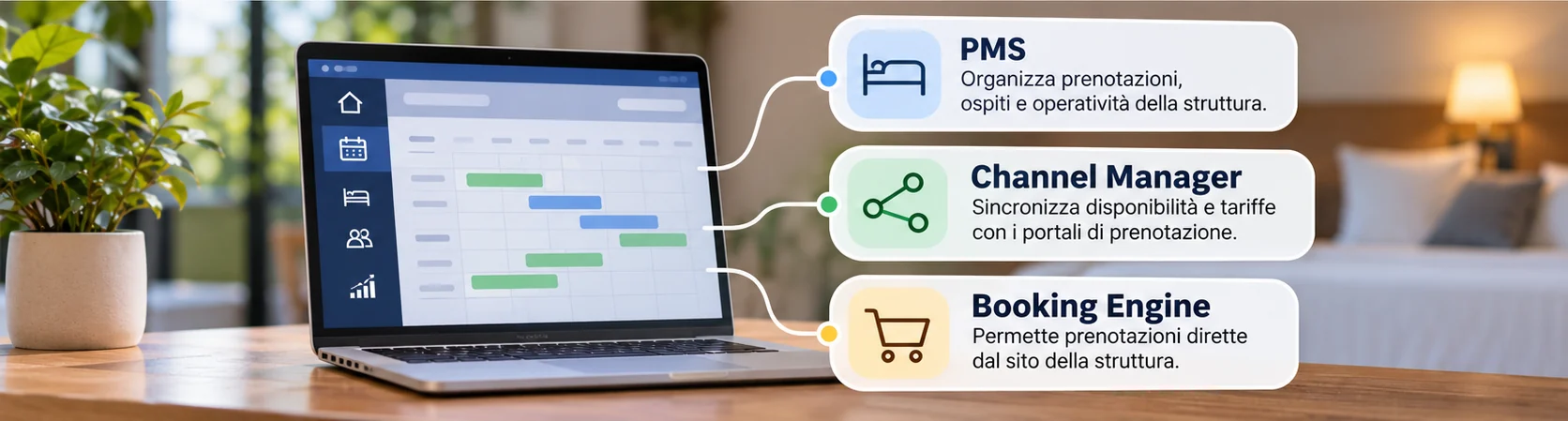
A booking calendar primarily shows when accommodation is occupied. A PMS — Property Management System — connects bookings with guests, rooms, availability, prices and the operational work surrounding each stay.
A calendar might tell you Room 3 is occupied from Friday to Monday. A PMS should help you see who is arriving, what was agreed, whether there are special requirements and what staff need to do before check-out.
That difference matters when the same person handles reservations in the morning, welcomes guests in the afternoon and checks tomorrow’s departures in the evening.
Not every small property needs complex hotel workflows. What matters is whether important information is connected and a simple task remains simple, even when something changes.
3. If a room looks free, is it actually available to sell?
An empty room is not automatically a sellable room.
It could be out of service, unsuitable for the requested number of guests or already allocated for a later arrival. A property might have a room free on each night of a three-night request without having the same room available for the whole stay.
Ask the software supplier to take one unit temporarily out of service, then try a booking across several nights. What happens when the booking requires a room change, or when an extra bed cannot be accommodated?
A useful system should distinguish occupancy, commercial availability and readiness for the next guest. It should expose conflicts clearly rather than give staff false confidence.
We explore this further in Vacant, available or ready? Why a hotel room can have three different statuses.
Test the complete guest journey, not just new reservations
4. What happens between an enquiry and a confirmed booking?
Some guests book immediately. Others ask about two room types, request a cot, negotiate a longer stay and take a few days to decide.
In that time, availability and rates may change.
Your software should let you understand what was offered, which conditions applied and what happens when the guest accepts. One especially useful question is: does sending a quote hold the room, or does it leave the inventory available to other guests?
There is no universal answer. Some systems offer temporary holds with expiry times; others treat quotations as proposals until a reservation is confirmed.
The important thing is that the operator can see what is promised, for how long and under which conditions. A quote should never create a commitment the property cannot reliably honour.
5. Can you change an existing booking without losing track?
A couple extend their visit. A family reduce the number of guests. Someone removes breakfast from a confirmed booking.
Each change can affect the bill, room allocation, inventory and the terms originally agreed.
During a demo, ask to edit a reservation that is already in the system. Does the software update the right amounts, preserve a record of significant changes and warn you when the new dates are not available?
Most importantly, could you explain the revised total to the guest without reconstructing it from memory?
Changes and exceptions are often a much better test of a PMS than creating a perfectly straightforward booking.
6. Does the software help after the guest checks in?
A reservation is only part of the work. Rooms need preparing; guests need welcoming; additional services and requests need managing; departures need coordinating.
A small guesthouse may not require a sophisticated housekeeping module. It may simply need a reliable answer to three questions: which rooms are ready, which need attention and which requests are still outstanding?
Think about different staff members, too. A cleaner may need access to arrival and departure information without seeing every guest’s financial or personal details.
Software should support the actual stay, with clear information for the people doing each job, rather than stopping at the moment a reservation is confirmed.
PMS, online distribution and direct bookings are different things
7. Is a PMS the same as a Channel Manager?
No. They may be sold together, but they solve different problems.
A PMS organises the property’s internal operations. A Channel Manager exchanges rates and availability with connected booking channels and, depending on the integration, brings reservations back into the property’s systems.
When a room sells on one online travel agency (OTA), other connected channels need accurate updates to reduce the risk of selling the same availability twice.
Ask which channels are supported now, how updates are handled, what information is exchanged and whether the Channel Manager is part of the quoted package.
The phrase “integrated solution” means little unless the supplier can show how that integration actually behaves.
8. Would a Booking Engine make a difference to your business?
A Booking Engine allows travellers to book directly through your property’s website, using the relevant rates and availability.
It isn’t another name for a PMS, and it isn’t the same as a Channel Manager.
For a guesthouse with few direct enquiries, a booking engine might be a sensible later investment. For a small hotel with an established website and repeat guests, direct online booking could be a more immediate priority.
Focus on what your guests actually do. Do they phone to book? Email for quotes? Use online travel agencies? Already visit your website expecting to reserve a room?
You do not need every tool on day one. You do need clarity about which systems should exchange information and whether any important task still requires manual copying.
9. Can the system explain how a guest’s total is calculated?
The room price may be only one part of the final bill.
Breakfast, parking, an extra guest, a cot or a late check-out can all affect the price. So can seasonal tariffs, special offers and individual arrangements with guests.
Ask for a demonstration of a personalised quote. If you agree a special rate with one guest, can the system apply it only to that booking without altering the standard tariff for everyone else?
Can staff see what is included, what is optional and which services have been removed or changed?
The goal is not to avoid flexibility. It is to offer flexibility without losing control of the numbers.
Consider trust, cost and what happens when your business changes
10. Who can see guest information, and how is it protected?
Property management software holds personal information about guests, stays and sometimes administrative documents.
Ask how access rights work, what information different staff roles can see, and what happens to an account when a team member leaves. You should also understand how records can be exported and, where applicable, deleted.
For European properties, GDPR and national rules are part of that discussion. Using cloud software does not automatically meet every legal requirement, nor does it remove the accommodation provider’s responsibilities.
Look for clear answers about permissions, data handling and contractual arrangements, not simply a generic claim that a system is “secure”.
11. What will the software really cost over twelve months?
The advertised monthly subscription may be only a starting point.
The final price could depend on room count, users, modules, channel connections, initial setup, training, support or importing records from your previous system.
Remember to distinguish the PMS fee from OTA commissions or charges imposed by payment providers and other services. Otherwise two quotes that appear similar may cover very different things.
Ask for a twelve-month cost based on the configuration your property will actually use.
There is also a less visible expense: the time spent each day fixing mistakes or repeating tasks. A cheaper product can become the more expensive choice if it regularly creates extra work.
12. If you wanted to switch software, could you take your records with you?
Few owners want to think about leaving a provider before they have even joined. Yet businesses grow, requirements change and services evolve.
Ask which information can be exported, in what formats and with what limitations. Guest records, future bookings, historic stays, prices and administrative information may not all transfer in the same way.
Migration between products is rarely guaranteed to be automatic. Understanding the constraints in advance gives you more control later.
This is also the time to ask how onboarding, staff training and support work — and what to do if the software is temporarily unavailable during a busy arrival period.
A management system should help organise your business, not make its records inaccessible.
One realistic demonstration is worth more than a long feature list
Imagine a six-room guesthouse heading into a busy weekend.
A guest enquires about three nights, but their preferred room is available for only two. They need a cot and would like an earlier check-in. You prepare a quote, they change their dates, and later they accept.
Ask the supplier to demonstrate this entire sequence. Watch how it checks room suitability, prepares the offer, handles the date change, confirms the booking and records what reception needs to know.
Then ask what happens when a request cannot be fulfilled.
Does the system explain why? Can an authorised member of staff make a sensible decision? Can you still see exactly what the guest was promised?
The most convincing demo isn’t one where nothing goes wrong. It’s one where a normal complication is handled clearly and consistently.
Frequently asked questions about B&B and small hotel software
What is the best property management software for a B&B?
There is no one-size-fits-all winner. The best fit depends on your accommodation, booking channels, staffing, price structure, integrations and total costs. Evaluate systems using realistic bookings and changes rather than relying only on feature comparisons.
Is a PMS worthwhile for a guesthouse with just a few rooms?
It can be. There is no universal minimum room count. A PMS becomes worthwhile when manual calendars, messages and spreadsheets cause repeated work, inconsistencies or booking errors. Operational complexity is usually more informative than size alone.
Does every small hotel need a Channel Manager?
No. Channel Managers are particularly useful when a property sells through several online booking channels and needs to synchronise information. A property using primarily one channel or direct enquiries may have different priorities.
How is cloud hotel software different from a locally installed system?
Cloud software is generally accessed via the internet, often through a browser, and hosted on infrastructure managed by the provider. Locally installed software depends on components running on the property’s own devices or infrastructure. Both require attention to access, maintenance, security and continuity.
How can I compare the true cost of different PMS products?
Compare the full cost of your actual configuration over a defined period, such as a year. Include modules, users, setup, integrations, support, external services and the time the software is expected to save.
Choose a system that suits your property, not someone else’s
A family-run guesthouse does not need to work like a hotel chain. A small hotel should not have to adopt complicated processes merely because its software offers them.
The right system connects information, makes everyday decisions easier and helps staff deliver what has been promised to guests.
Instead of asking only “How many features does it have?”, ask “What will our working day look like with this system?”
If a supplier can answer that question with realistic examples, clear pricing and a sensible approach to exceptions, you are much closer to making a useful decision.
How OpenBuuk approaches small-property management
OpenBuuk is a cloud PMS platform designed with B&Bs, guesthouses and small hotels in mind. Its approach brings reservations, accommodation availability, guest information and daily operations into a connected workflow.
OpenBuuk is currently preparing for launch. Some features and integrations are being developed in stages, so it is important to distinguish what is available now from what is planned. Contact us to discuss your property, check current availability and request a demonstration.