
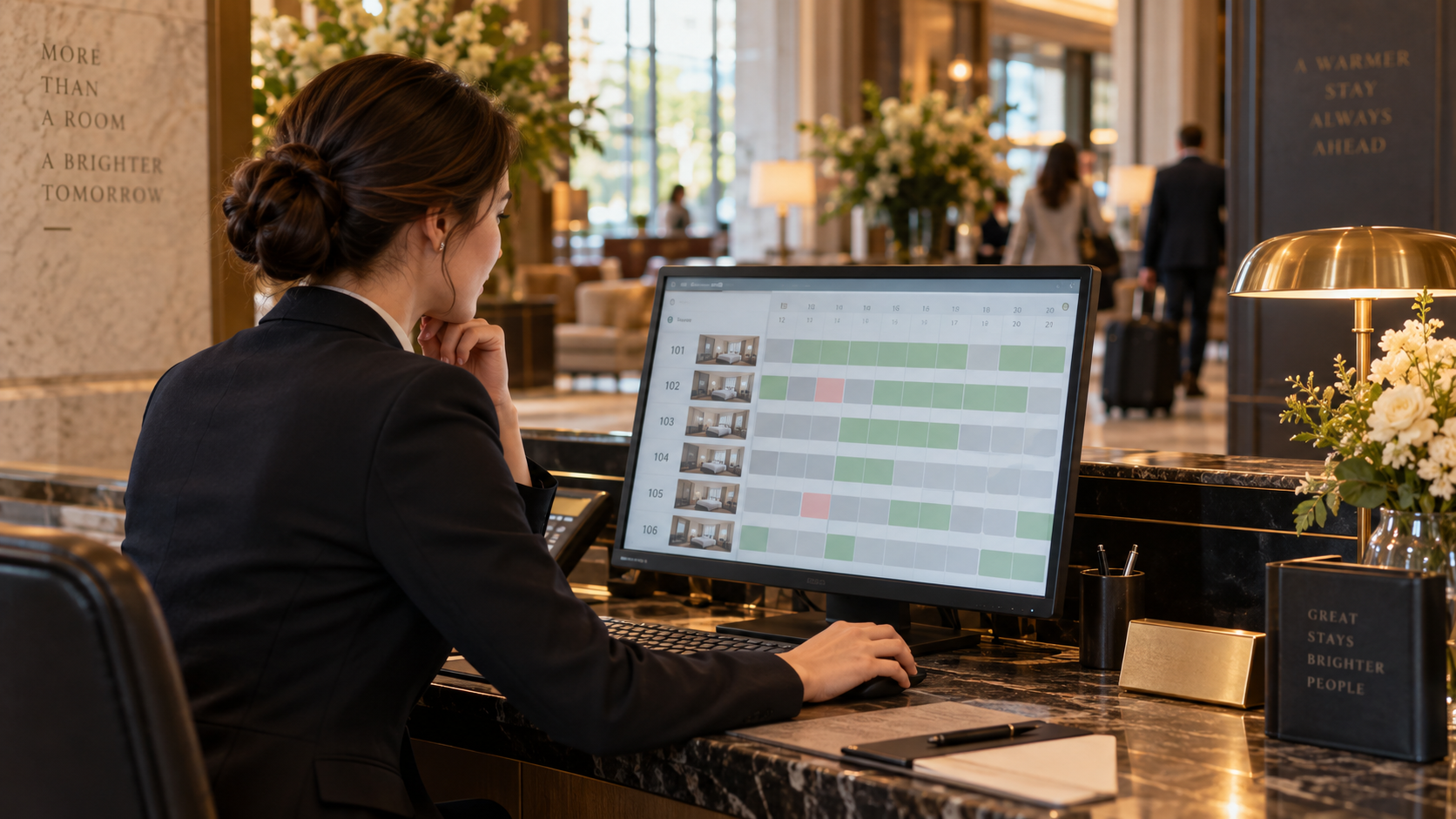
A guest is looking for a double room for four nights. The PMS shows availability, but when the operator looks at the planning board, one detail appears:
- room 101 is free for the first two nights;
- room 102 is free for the last two;
- neither room is available for all four nights.
At that point the obvious question is:
does the property really have availability for that stay?
The answer is:
it depends on what we mean by availability.
Having one room of the requested room type available on every night does not necessarily mean having the same physical room available throughout the stay. That distinction matters much more than it may seem.
Room-type availability and physical room continuity are not the same thing
Imagine a property with two rooms in the same commercial room type: Standard Double.
| Night | Room 101 | Room 102 |
|---|---|---|
| 10 June | free | occupied |
| 11 June | free | occupied |
| 12 June | occupied | free |
| 13 June | occupied | free |
For all four nights, at least one Standard Double is free. So if we look only at room-type availability, we could say: four nights available.
But no single physical room can accommodate the same guest for the whole stay. To make the booking work, the guest would need:
- room 101 for the nights of 10 and 11 June;
- a room move on 12 June;
- room 102 for the nights of 12 and 13 June.
Commercial availability exists, physical continuity does not, and those are two different pieces of information.
So can the property accept the booking?
In theory, yes. But the PMS should not automatically decide that the guest can be moved from one room to another. The property needs to know that the booking requires a room move and consciously decide whether that is acceptable.
The key point is this: lack of physical continuity should never be hidden. A system that simply displays 1 room available without explaining that the availability is created by combining different physical rooms may lead an operator to sell the stay assuming that it is fully continuous. The problem may only emerge a few days before arrival or, in the worst case, after the guest is already at the property.
A room move is not a technical detail
From the software’s point of view, it may look simple: move the guest from room 101 to room 102. Operationally, however, much more is involved. The guest may need to:
- pack personal belongings;
- vacate the first room;
- wait for the next room to be prepared;
- receive a new key or key card;
- move luggage and personal items.
The property must:
- coordinate reception and room operations;
- know when the first room has actually been vacated;
- prepare the second room;
- carry across any special requests;
- make sure the move does not interfere with other arrivals;
- manage luggage during the transition where necessary.
What looks like a simple 101 → 102 transition on a planning screen is, for the guest, an interruption in the stay. That is why it should not be treated as something invisible.
“But they are the same room type”
That is a reasonable objection. If both rooms are Standard Doubles, why should it matter? Commercially, the two rooms may be equivalent, but physically they are still different rooms. They may be:
- on different floors;
- in different areas of the property;
- facing different directions;
- slightly different in layout or features;
- closer to or further from the lift;
- configured differently in small but relevant ways.
Even when they are commercially identical, the guest still needs to move.
The room type describes what we sell, while the physical room describes where the guest actually stays. The two concepts are related, but they are not interchangeable.

Availability should answer two different questions
When we search availability for a stay, we are really asking two separate questions.
The first:
Is there enough commercial capacity for every night requested?
The second:
Is there at least one physical room that can accommodate the guest for the whole stay?
Returning to our example, the answer to the first question is yes, while the answer to the second is no.
Both answers are useful, and hiding the second removes an important part of the operational reality.
The room does not always need to be assigned immediately
There is another important distinction here. Checking physical continuity does not mean that the final room number must be assigned today.
A booking made six months before arrival may simply be sold as “1 Standard Double” without yet knowing whether the guest will stay in room 101, 102 or 105.
Physical allocation can happen much later, but the system can still determine whether, considering the rooms in that type and the commitments already in place, at least one continuous solution is possible.
These are two different concepts: the room has not yet been allocated does not mean continuity cannot be checked.
The problem of future room assignments
The situation can become even more interesting. Imagine three rooms of the same type and several future bookings already on the books. At first glance, no room appears to be free for five consecutive nights, but some future bookings have not yet been permanently assigned to a specific physical room. By rearranging flexible assignments between equivalent rooms, the property may be able to create a continuous stay without asking the guest to move at all.
In other words:
continuity does not always depend on the current snapshot of the planning board; it may depend on whether future assignments can still be reorganised. This is where a simple occupied/free grid starts to become insufficient. A good system should be able to distinguish at least between:
- continuity already available;
- continuity achievable by rearranging flexible future assignments;
- availability possible only with a room move during the stay;
- no feasible availability.
Those are four commercially different situations.
When a room move may be acceptable
A room move is not something that must always be avoided, because it can be a conscious commercial choice.
For example:
a guest requests a full week during peak season;
the property has no single room available for the whole stay;
the guest explicitly agrees to spend four nights in one room and three in another.
At that point the booking can be perfectly manageable, but it must be a decision, not a hidden consequence of the availability engine. Ideally, the operator should see something like:
Availability exists, but without same-room continuity.
and then decide whether to:
- offer the stay anyway;
- change the dates;
- look for another room type;
- offer an upgrade;
- propose a room move explicitly;
- decline the stay.
What about the booking engine?
This becomes even more delicate online because reception staff can explain the situation, while a booking engine works automatically.
If it displays availability without checking physical continuity, it may allow a guest to book a stay that necessarily involves a room move without ever being told. That makes the situation commercially risky.
One possible approach is therefore to distinguish between:
automatic sellability
where a solution exists within the property’s standard rules;
sellability requiring operator intervention
where the stay is theoretically possible but requires a room move or another explicit decision.
The booking engine does not need to turn every operational complexity into “unavailable”, but it should not hide it either.
Do not confuse capacity with continuity
This example also shows why a simple count of available rooms does not always tell the whole story. Imagine a room type with 10 physical rooms.
For every night of the requested stay, the system shows:
availability: 1 — so the number is always positive.
It may therefore appear that the stay is sellable, but if that single available room is a different room every night, a continuous physical solution may not exist.
Capacity by night is one thing, while compatibility across the full stay is another. The two concepts should not be confused.
That is why a search from 10 to 15 June should not only ask:
“Do I have at least one room available on the 10th? The 11th? The 12th? The 13th? The 14th?”
It should also ask:
“Is there a coherent solution for the whole stay?”
What if the room type changes during the stay?
The case may become even more complex.
There could be:
- two nights in a Standard Double;
- three nights in a Superior Double.
Technically, a solution exists. Commercially, however, we are no longer talking about the same room type.
It may represent:
- an upgrade;
- an explicit guest choice;
- a solution proposed by the property to recover availability;
- a booking amendment.
Again, the system should avoid automatic assumptions. Using two equivalent physical rooms within the same room type is one thing; changing the commercial product during the stay is another.
Why this problem is often discovered late
Many PMSs manage inventory very well: for every day, they calculate how many rooms remain available in each room type. That information is essential, but if the system stops there, it may fail to surface physical-room continuity early enough and the result can look perfectly correct:
availability = 1 for every date.
The booking is accepted, and only during room allocation does the operator discover that no continuous room exists.
At that point, someone has to solve the puzzle. Sometimes rearranging a few assignments is enough, sometimes a room move is required, and sometimes there is simply no acceptable solution. The earlier the issue becomes visible, the more options the property has.
What should a PMS show?
A hotel PMS should avoid compressing all of these situations into a single number called “availability”.
An availability search could distinguish, for example:
Available with continuity
there is at least one solution in which the guest can remain in the same physical room throughout the stay.
Available with reorganisation
continuity can be achieved by rearranging future assignments that are still flexible.
Available with a room move
capacity exists on every night, but at least one physical transfer is required.
Unavailable
there is insufficient capacity on one or more nights.
Those do not necessarily need to be the exact labels shown in the interface, but the system should understand the distinction.
The software should not decide instead of the property
There is an even more important principle. The PMS can identify the problem, show alternatives and suggest a possible combination. But the decision to move a guest from one room to another should remain a commercial and operational decision made by the property, because it may depend on factors that a simple availability algorithm does not fully understand:
- length of stay;
- booking value;
- returning or first-time guest;
- children travelling with the guest;
- reduced mobility;
- amount of luggage;
- type of property;
- service level;
- time of year;
- upgrade possibilities;
- preferences already communicated by the guest.
A mathematically possible solution is not always the commercially correct one.
A very simple example
Let us return to the original four-night stay.
The search result says:
Standard Double — available
But the detail says:
No continuous physical room available.
Possible solution: room 101 for 2 nights + room 102 for 2 nights.
Now the operator finally has the information needed to make a decision.
They may decide:
“Fine, the guest has already agreed to the move.”
Or:
“No, I will look for a Superior room available for all four nights.”
Or:
“I can reorganise two future assignments and keep the guest in room 102 for the entire stay.”
The software has done its job. It has not simply answered yes or no: it has shown the real shape of availability.
The right question is not only “how many rooms do I have?”
Hospitality teams talk about availability all the time, but behind that single word there are at least two different questions:
how much capacity can I still sell?
and
can I physically accommodate this booking without interrupting the stay?
A property may have commercial availability for every requested night and still not have one physical room available for the entire interval.
That is not a contradiction. It is simply the difference between room-type inventory and physical room continuity. When a PMS can show both, the operator can make a genuinely informed decision.
Because having one room available every night does not necessarily mean: having the same room available for the whole stay.