
Updated 14 October 2026
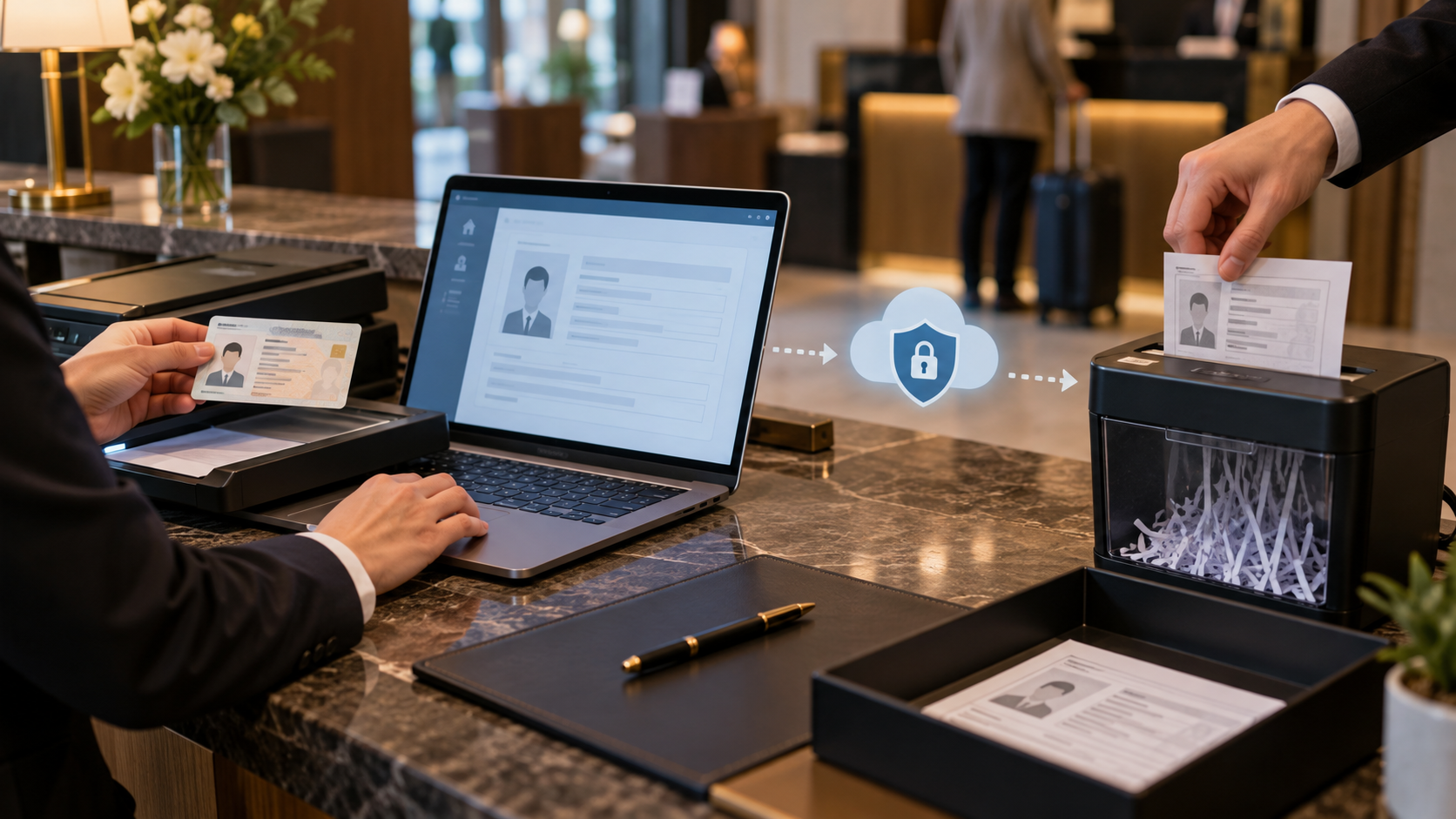
At reception, the scene is completely normal. The guest hands over an identity document. Staff read the details, enter them into the PMS or use a scanner that extracts the data automatically.
Some properties make a photocopy. Others save a scan. In smaller accommodation businesses, staff may even take a picture with a smartphone or ask the guest to send the document through WhatsApp before arrival.
The question seems simple:
once check-in is complete, can the accommodation provider keep that copy?
For the Italian public-security reporting obligation, the answer is now very clear:
the copy of the identity document should not become a permanent archive of the property.
The document is needed to identify the guest and obtain the information required for the statutory notification. If a paper or digital copy is temporarily created for that purpose, once the information has been correctly transmitted and the Alloggiati Web receipt has been obtained, that copy must be deleted or destroyed.
Italy’s Data Protection Authority, the Garante, stated this explicitly in a clarification dated 29 April 2026 addressed to accommodation-sector associations.
Identifying the guest is mandatory
Let us start with what an accommodation provider operating in Italy is required to do.
Article 109 of the Italian Consolidated Public Security Act requires accommodation providers to host only persons whose identity can be established through a suitable document and to communicate guest details to the public-security authority. The official Alloggiati Web FAQ published by the Italian State Police reflects the same requirement.
The property therefore needs to:
- identify the guest correctly;
- collect the information required by law;
- submit it through Alloggiati Web according to the applicable procedure.
The legal basis for this processing is not guest consent. It is compliance with a legal obligation, under Article 6(1)(c) of the GDPR.
But identifying a person and indefinitely retaining a copy of their ID are two very different operations.
The document is used to obtain the data, not to build an ID archive
This distinction is the key point. Italian law requires the accommodation provider to communicate specific data. It does not require the hotel, B&B or other property to retain a photograph, scan or photocopy of the guest’s identity document for that purpose.
The Garante’s clarification of 29 April 2026 states that the obligation under Article 109 concerns communication of guest data to the public-security authority and does not create a requirement to retain the identity-document copy at the property for that purpose.
The document is therefore a means of verifying and accurately acquiring information such as the guest’s name, date and place of birth, nationality, document type, document number, place of issue and the other information required for the statutory notification.
That does not automatically justify keeping the full image of the identity document.
What if reception uses a document scanner?
This is probably the most common case in organised properties. Many systems can scan or read an identity document and automatically populate the guest record. This is useful: it speeds up check-in and reduces typing errors.
The issue is not necessarily the temporary acquisition required to read the document. The issue is what happens afterwards.
The Garante expressly recognises that a copy may be temporarily acquired as part of the process used to enter data for Alloggiati Web, but states that once the receipt confirming transmission is generated, any digital copy must be deleted and any paper copy created for that purpose must be destroyed.
In practical terms:
scan to read the required data → can be part of a compliant process;
keep the scan because “it might be useful later” → not justified merely by the Alloggiati Web obligation.

Does the PMS store the data, or the full document image as well?
This is a question every accommodation provider should ask its software supplier. It is not enough to know that the PMS “reads identity documents”. The property needs to know what is actually stored. A system may read the document, extract the required data, populate the guest record, prepare the Alloggiati Web transmission and then delete the image.
Another system may perform the same operations while also retaining the complete photograph of the document. Operationally, the two solutions may look identical. From a data-protection perspective, they are very different. The property should know whether a digital copy is generated, where it is temporarily stored, how long it remains available, when it is deleted, whether backups contain it and who can access it.
The Garante also refers specifically to Article 28 GDPR: the relationship with hotel-management software providers and other processors involved in document acquisition must be properly governed, with appropriate procedures in place, including for personal-data breaches.
Taking a photo with a smartphone? The Garante says to avoid it
This is especially relevant for B&Bs, apartments and smaller accommodation providers. It can seem convenient to say:
“Send me a photo of your ID on WhatsApp.”
Or:
“Let me photograph your identity card and I will enter the data later.”
This is exactly the type of practice highlighted by the Garante. In its 29 April 2026 clarification, the Authority asks accommodation providers to collect identity-document data without photographing documents with mobile devices and without relying on instant-messaging services such as WhatsApp, or otherwise using methods that do not provide appropriate safeguards.
A smartphone photo may end up in the device gallery, personal cloud backups, the app history, synchronised devices or messaging backups. At that point it becomes much harder for the property to know where the document actually exists and when every copy has been deleted.
What about online check-in?
The principle is the same. A digital process can make check-in more efficient, but it should distinguish between acquiring the information needed and retaining the document image. If the online check-in system asks the guest to upload an identity document so that data can be extracted automatically, the property should know what happens to the file after processing.
The Garante also states that where devices capable of acquiring and storing digital copies are used, guests should be clearly informed that the property will not archive the images. This article does not address the separate question of how guest identity may be verified remotely. That is a different issue from retention of an ID copy.
After the Alloggiati Web submission, what should be deleted?
The Garante’s clarification is practical. Once the receipt confirming successful transmission has been generated:
digital data and digital copies retained solely for that notification must be deleted;
paper copies created for that purpose must be destroyed.
This reflects two core GDPR principles:
data minimisation — keep only what is necessary;
storage limitation — do not retain personal data for longer than required by the purpose for which it was collected.
“We keep it because it may be useful someday” is not, by itself, a sufficient purpose.
Guest-record data and the ID copy are not the same thing
This point is important to avoid the opposite misunderstanding. Deleting the ID copy after the public-security reporting process does not necessarily mean that every piece of guest information must disappear from the PMS at the same time. The property may have other lawful purposes for processing certain data, including reservation management, the accommodation contract, invoicing, tax and accounting duties, payment management or other statutory obligations.
But the distinction must remain clear.
Having a lawful reason to retain certain guest data does not automatically create a lawful reason to keep a complete image of the identity document.
Any further processing needs its own purpose, legal basis and compliance with GDPR principles. The Alloggiati Web obligation alone does not justify continued retention of the copy.
What should be retained instead: the receipt
If the identity-document copy should not be kept, what should the property retain to prove that the notification was made?
The Alloggiati Web receipt.
The official Italian State Police FAQ states that receipts must be retained digitally for five years.
There is another important operational detail.
The receipts remain downloadable from the portal for only 30 days from issue.
A property should therefore have a clear procedure:
submit → verify receipt → download receipt → archive receipt → delete any temporary ID copy.
Keeping more data does not mean being more cautious
In day-to-day operations, keeping an extra copy can feel safer. With identity documents, the opposite is often true. Passports and identity cards contain valuable information for identity theft and fraud. The more copies a property retains, the more systems need protection, the more people may potentially access the information, the more backups can contain it and the greater the impact of an incident.
The Garante explains that its 2026 clarification also followed increased reports concerning document retention and data breaches involving the exfiltration of large numbers of guest ID copies. Deleting data that is no longer needed is therefore not just a formal GDPR exercise. It is a security measure.
What happens if ID copies are stolen?
A breach involving passport or identity-card images can be particularly serious. Under the GDPR, where a personal-data breach is likely to result in a risk to people’s rights and freedoms, the controller must notify the supervisory authority without undue delay and, where feasible, within 72 hours of becoming aware of it. Where the risk is high, communication to the affected individuals may also be required.
The Garante specifically recalls these obligations when discussing guest identity-document copies.
Staff also need clear instructions
A technically correct process can easily fail if employees do not know what they are expected to do. The Garante expressly states that staff collecting and processing guest information should receive precise instructions not to retain paper or digital copies after the statutory notification has been completed.
The procedure should therefore be clear to reception staff, administrative staff, collaborators and external operators involved in check-in. It should not depend on the habits of an individual employee.
What should a PMS do?
A hotel PMS should help the accommodation provider preserve the distinction between the data it needs and the original identity document.
Ideally, the process should allow the property to:
- capture required document data efficiently;
- reduce transcription errors;
- prepare the Alloggiati Web submission;
- track the result of the submission;
- retain the receipt;
- avoid unnecessarily retaining the complete document image;
- control roles and permissions;
- keep the process traceable.
Automation should not turn a temporary processing step into permanent retention simply because storing an image is technically easy.
A practical procedure for accommodation providers
- identify the guest using a suitable identity document;
- collect only the information that is necessary for management and statutory duties;
- submit the required information through Alloggiati Web;
- verify that the receipt has been generated;
- download the receipt within the 30-day portal window;
- retain it digitally for five years;
- delete any digital scan or copy used solely for the reporting process;
- destroy any paper copies that are no longer required;
- check that software, scanners and external services are not retaining additional copies;
- provide clear instructions to staff.
The principle to remember
The guest’s identity document must be checked.
The required information must be reported.
The transmission receipt must be retained.
The identity-document copy, however, should not automatically become part of the property’s permanent archive.
These are four separate operations. Keeping them separate is how an accommodation provider can meet public-security duties, protect guest privacy and maintain an efficient operating process at the same time.
Official sources
Information verified as of 14 October 2026.
- Italian Data Protection Authority (Garante) — clarification on processing identity documents of hotel and accommodation guests, 29 April 2026.
- Italian State Police — official Alloggiati Web FAQ, accessed 14 October 2026.
- Regulation (EU) 2016/679 — GDPR, particularly Articles 5, 6, 28, 32, 33 and 34.
- Article 109 of Royal Decree 18 June 1931, no. 773 (Italian Consolidated Public Security Act), as referenced by the Garante and the Italian State Police.
- Italian Ministry of the Interior Decree of 7 January 2013, as amended by the Decree of 16 September 2021, concerning guest reporting to the public-security authority.
Time-sensitive note: legal requirements, official guidance and online-service procedures may change. Accommodation providers should verify the current official sources before applying the information in this article.
Disclaimer: this article is for informational purposes only and does not constitute legal, privacy or professional advice. The information reflects the sources verified on the update date shown above. Where a property wishes to retain identity-document copies for another purpose, it must assess that separate processing activity and its legal basis and, where appropriate, obtain qualified professional advice.